What Is NFP and Why Does It Matter for XAU/USD?
My Approach to NFP, Inflation, Monetary Policy and Gold Trading
By Yaipubi Chanu | YAI — Spot Gold XAU/USD
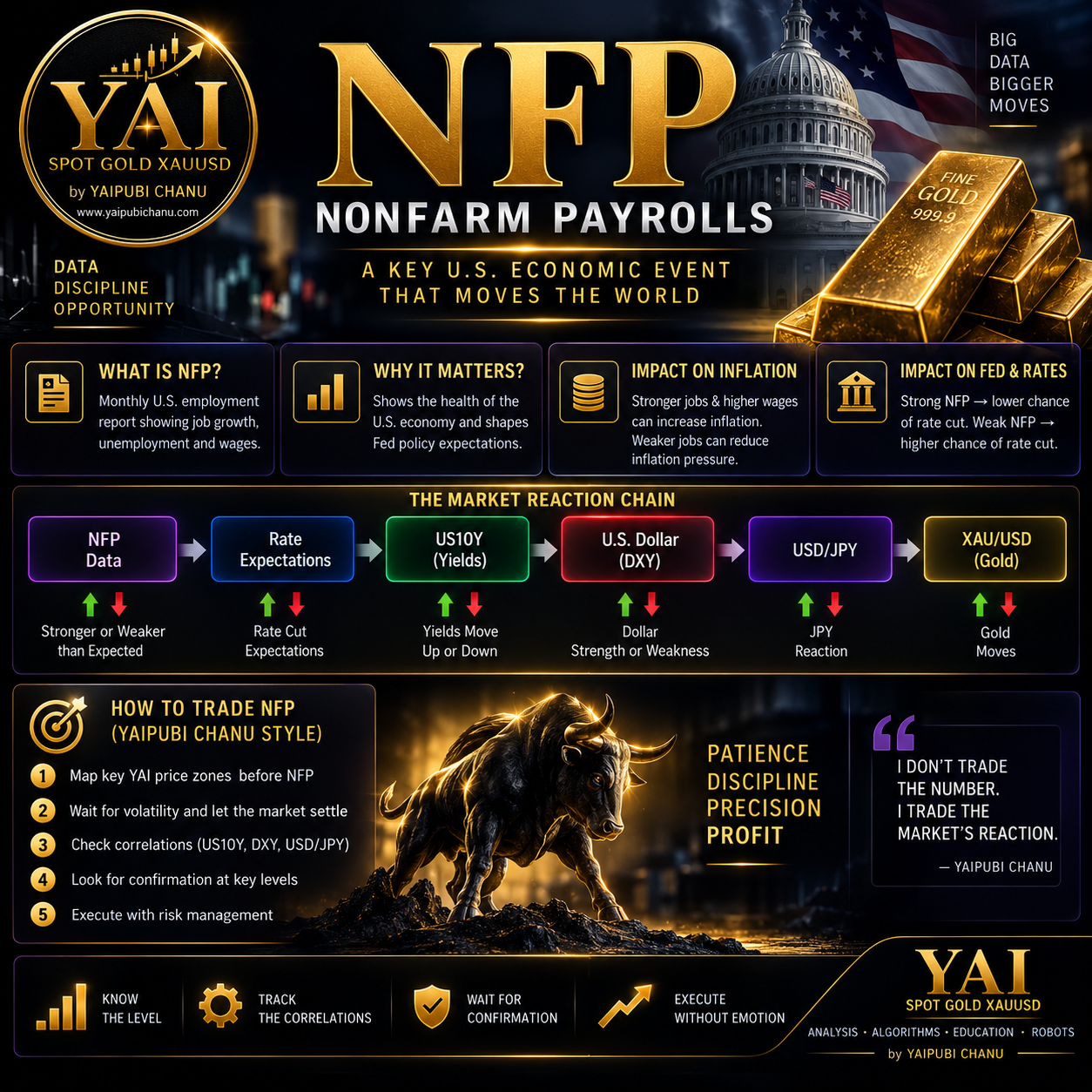
For me, Nonfarm Payrolls (NFP) is not simply another economic number on the calendar. It is one of the most important monthly events for understanding the strength of the U.S. economy and, more importantly for my trading, how expectations for Federal Reserve monetary policy, Treasury yields, the U.S. Dollar and XAU/USD may change.
My objective during NFP is not to predict whether the first candle will be green or red. I want to understand the chain reaction created by the employment data and then trade Gold only when price, liquidity and correlations provide sufficient confirmation.
What is NFP?
NFP is part of the U.S. Bureau of Labor Statistics’ monthly Employment Situation report. Traders commonly use “NFP” as shorthand for the change in nonfarm payroll employment, but I never look at that headline number alone.
The employment report also contains information such as the unemployment rate, average hourly earnings, labor-force participation and revisions to previous payroll estimates. Together, these give a much better picture of U.S. labor-market conditions than the headline payroll figure alone.
This matters because the Federal Reserve has a mandate that includes maximum employment and stable prices. The Fed currently defines its longer-run price-stability objective as 2% inflation measured by the PCE price index.
Therefore:
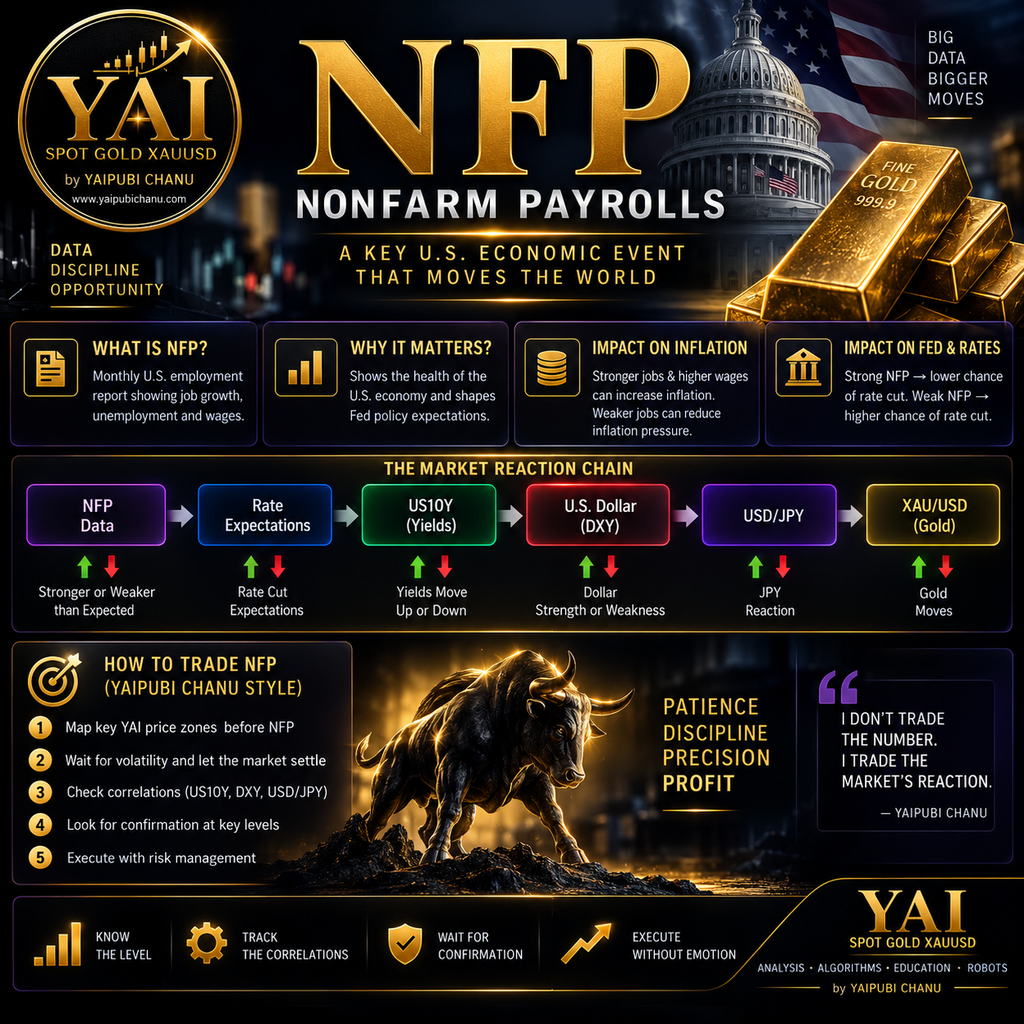
NFP → Labor Market → Wages/Inflation Expectations → Fed Expectations → US10Y/Real Yields → DXY/USDJPY → XAU/USD
That is the chain I want to understand.
Why NFP Is Important for Gold
Gold does not pay interest.
Consequently, changes in interest-rate expectations and bond yields can materially change the relative attractiveness of holding Gold.
Suppose NFP is significantly stronger than expected, unemployment remains low and wage growth is unexpectedly strong. Markets may conclude that economic demand remains resilient and that the Federal Reserve has less reason to cut rates.
The possible reaction becomes:
Strong NFP → Rate-cut expectations ↓ → Treasury yields ↑ → USD ↑ → Gold pressure
But a weak NFP can produce the opposite repricing:
Weak NFP → Rate-cut expectations ↑ → Treasury yields ↓ → USD ↓ → Gold support
These are scenarios, not fixed rules.
I consider that distinction extremely important.
NFP and Inflation
Employment does not mechanically determine inflation.
However, a very tight labor market can contribute to stronger wage growth and demand. If businesses face rising labor costs while consumer demand remains strong, inflationary pressure can become more persistent.
Conversely, substantial deterioration in employment can reduce household income growth and aggregate demand, potentially reducing inflation pressure over time.
The Federal Reserve itself explains that monetary policy works partly by influencing financial conditions, household and business spending, economic activity, employment and ultimately inflation.
Therefore, I pay particular attention to Average Hourly Earnings.
A headline NFP miss combined with unexpectedly high wage inflation can create conflicting signals.
For example:
NFP weak + unemployment higher + wages weak
= stronger dovish interpretation.
But:
NFP weak + unemployment stable + wages strong
= much more complicated.
This is where blindly trading the headline number becomes dangerous.
NFP and Federal Reserve Monetary Policy
The Federal Reserve does not set interest rates based on NFP alone.
It examines a broad range of economic information, and current Fed leadership has explicitly emphasized looking at trends rather than isolated data points.
This is why I combine NFP with:
CPI • PCE • GDP • Jobless Claims • Wage Growth • US10Y • Real Yields • DXY • USD/JPY
When employment remains strong and inflation is elevated, the Fed has greater flexibility to maintain restrictive monetary policy.
When employment deteriorates materially while inflation is moving toward target, the argument for easing becomes stronger.
Demand (MD / AD)
Supply (MS / SRAS)
Long-run supply (LRAS)
Money market
AD–AS2468105MoneyInterest rate2468105Real GDPPrice level
Money ↑→Rate ↓→Investment ↑→AD ↑
More money lowers the interest rate to 3.9, raises investment, and shifts AD right
Policy typeExpansionaryContractionary
ExpansionaryContractionary
Policy strength
Policy strength
Give feedback
Changes in the federal funds target influence other interest rates and broader financial conditions, which then influence spending, employment and inflation.
For Gold traders, we therefore need to think one or two steps beyond NFP itself.
NFP and Rate Cuts
One of the biggest mistakes I see is:
“Bad NFP = Rate Cut = BUY Gold.”
It is not that simple.
Imagine NFP comes below expectations. Gold initially rallies because traders increase their expectations for a rate cut.
Then Treasury yields reverse higher because wage growth was unexpectedly strong, inflation concerns remain elevated, or the previous NFP number receives a large upward revision.
DXY could recover.
Gold could then surrender its entire initial rally.
This is exactly why I prefer to watch what the bond and currency markets actually do after the number, rather than trading only what I think NFP should mean.
How I Trade NFP — The YAI Approach
My NFP strategy begins before the release, not at the release.
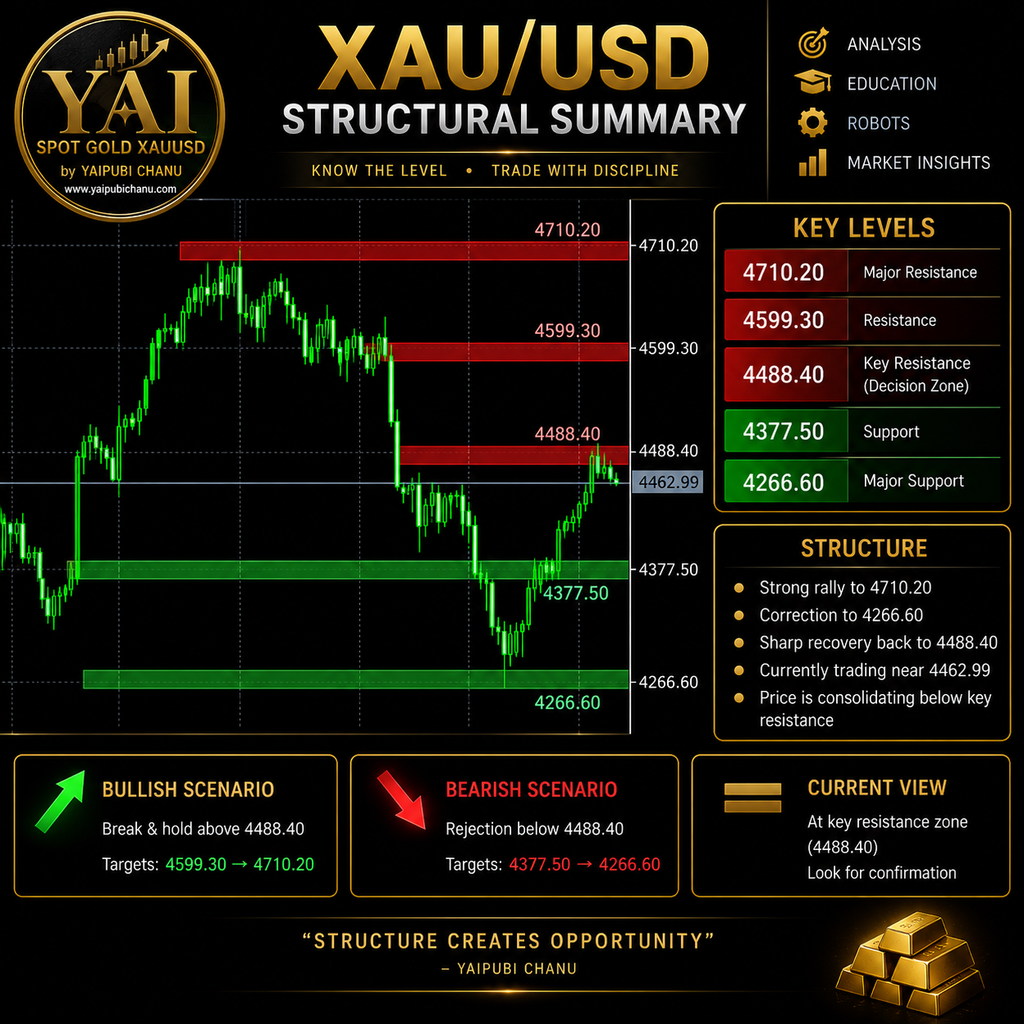
I first map important YAI Cluster Price Zones and identify where Gold is trading relative to important support, resistance, liquidity and moving-average structures.
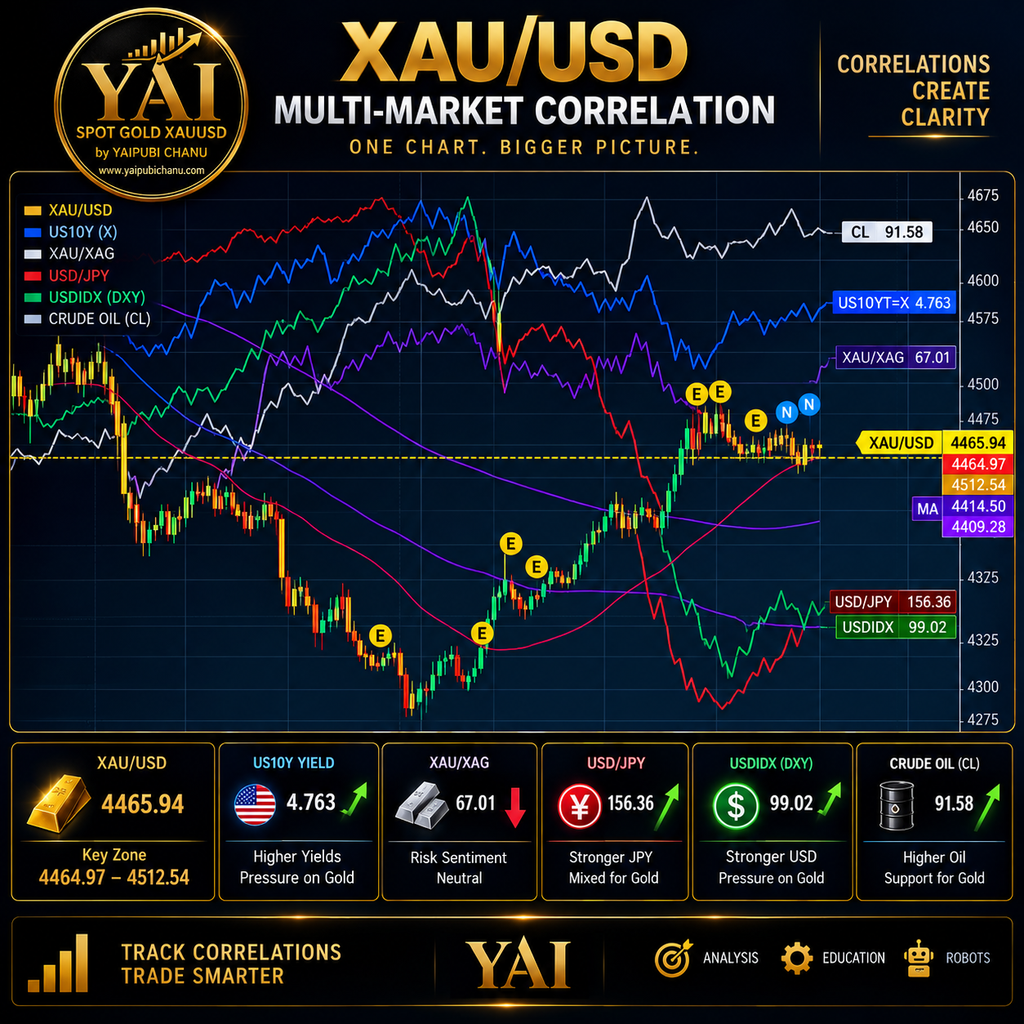
Then I monitor my major correlations:
US10Y • Real Yields • DXY • USD/JPY • XAU/XAG • Crude Oil
When NFP arrives, I avoid assuming that the first reaction represents the real direction.
The first few minutes can contain extraordinary volatility, spread expansion, liquidity sweeps and rapid reversals.
My preferred process is:
DATA → REACTION → CORRELATION → PRICE ZONE → CONFIRMATION → EXECUTION
Not:
DATA → EMOTION → TRADE
The First 15–45 Minutes Matter
Immediately after NFP, algorithms and institutional systems process several components simultaneously.
The headline payroll number may say one thing.
Unemployment may say another.
Wages may contradict both.
Previous months may also be revised significantly.
That is why Gold can initially jump $20, reverse $30, recover $40 and then establish an entirely different trend.
I would rather miss the first part of a move than enter an uncontrolled liquidity event without confirmation.
I watch whether the initial NFP reaction survives approximately the next 15–45 minutes, depending on volatility.
Correlations Are My Confirmation
Suppose Gold falls sharply after NFP.
Before treating that move as structurally bearish, I want to examine:
US10Y ↑?
Real yields ↑?
DXY ↑?
USD/JPY ↑?
If these variables broadly confirm the move, the macro pressure on Gold has stronger justification.
But suppose Gold crashes while US10Y falls, DXY falls and USD/JPY falls.
Now I become interested.
The correlation structure is not confirming the Gold selloff. That could indicate a liquidity sweep, temporary dislocation or potential reversal environment.
This is where patience becomes more valuable than speed.
Why I Avoid SHORTS
My YAI execution philosophy remains focused on buying strategically selected Gold lows rather than chasing downside moves.
During NFP, a $50–$100 decline can look frightening on the chart. But if that decline brings Gold into an important YAI Cluster Zone while correlations begin reversing, I am more interested in evaluating a confirmed buying opportunity than emotionally selling after the crash.
The objective is not to catch the exact bottom.
I prefer controlled entries around predefined zones, appropriate risk management and an exit based on Net Average Profit (NAP) when using multiple positions.
My NFP Framework
For me, professional NFP trading can be summarized as:
Before NFP:
Map the price zones.
At NFP:
Observe—do not chase.
After NFP:
Read yields, DXY and USD/JPY.
At the YAI Cluster:
Wait for confirmation.
After confirmation:
Execute with controlled exposure.
In profit:
Manage toward NAP rather than becoming emotionally attached to an unrealistic target.
Conclusion
NFP is powerful because it connects several of the most important forces affecting Gold:
Employment → Wages → Inflation → Fed Policy → Interest Rates → Treasury Yields → Dollar → XAU/USD
But NFP itself is only the beginning of the process.
At YAI, I do not want to trade a number. I want to trade the market’s reaction to that number.
The difference is important.
My focus remains on combining economic data, correlations, liquidity, price structure and YAI Cluster Price Zones before execution.
NFP can create exceptional volatility. That volatility can also create opportunity—but only when accompanied by discipline.
Know the data. Map the level. Track the correlations. Wait for confirmation. Execute without emotion.
— Yaipubi Chanu
YAI | Spot Gold XAU/USD